

_edited.png)
Is Your Workplace Violence Prevention Plan Truly Alberta OHS Compliant?

Mastering Part 27: The Employer’s Framework for Alberta OHS Violence Prevention

Workplace safety extends beyond slips, trips, and falls. It also includes risks arising from interactions with other people—from aggressive clients and threatening coworkers or former employees to domestic violence affecting the workplace.
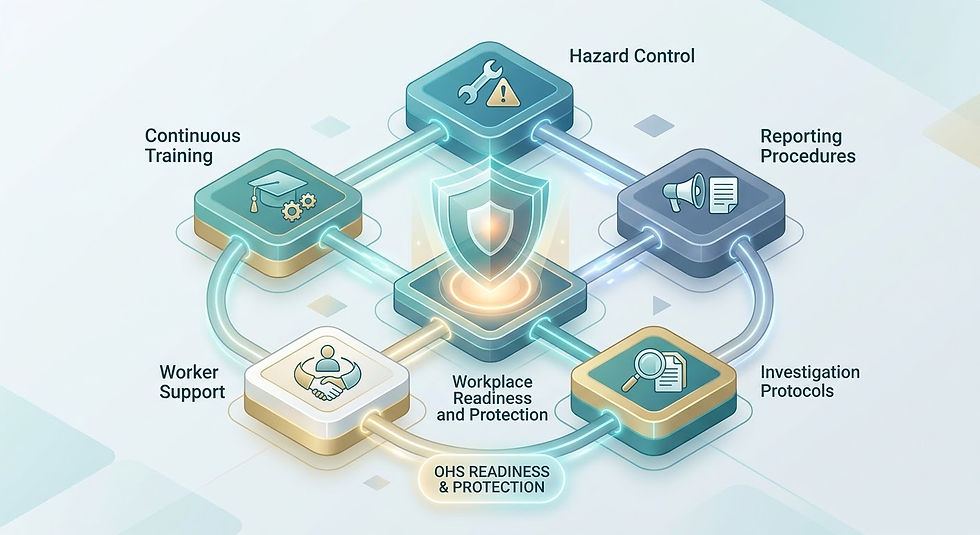
In Alberta, violence and harassment are officially recognized as workplace hazards. Employers have legal responsibilities to identify these hazards, implement practical controls, establish formal reporting procedures, train workers, and investigate all incidents.
This guide focuses on workplace violence prevention and translates Alberta OHS requirements into practical steps your organization can use. Your prevention plan must also address workplace harassment.
Sneak peek: Read to the bottom of this article and get a Free Alberta Workplace Violence Prevention Checklist that you can use for your organization!
Disclaimer: This guide offers general OHS information, not legal advice. Employers should consult current legislation or legal counsel for specific guidance.
Which Organizations Must Comply?
If your organization is governed by Alberta OHS legislation and employs workers, workplace violence and harassment requirements apply to you—regardless of your company's size.
Unlike general health and safety programs that kick in at 20 workers, there is no minimum worker threshold for the violence and harassment prevention plan required under Part 27 of Alberta's OHS Code. Employers must address risks proactively before an assault or threat occurs.
(Note: Workplaces in federally regulated industries fall under separate federal OHS legislation.)
How Alberta OHS Defines Violence
Alberta OHS legislation defines violence broadly as threatened, attempted, or actual conduct that causes (or is likely to cause) physical, or psychological harm, explicitly including domestic and sexual violence spilling into the workplace. Because risks vary dramatically from one organization to another, compliance begins with a structured hazard assessment.
Seven Steps to Put Workplace Violence Prevention into Practice
Effective prevention starts with understanding the risks your workers face, then putting controls, procedures, and training in place to address them. The seven steps below walk employers through assessing hazards, controlling risks, developing a prevention plan, training workers, practising responses, investigating incidents, and reviewing the program.
This framework combines Alberta OHS requirements with practical ways to put them into action. Each step builds on the others to help your organization prevent incidents, respond effectively, and improve over time.
1. Conduct a Workplace Violence Hazard Assessment
Under Alberta's OHS Code, employers must assess their workplace for existing and potential violence and harassment hazards based on actual working conditions and foreseeable operational risks.
A thorough assessment evaluates key friction points across four main categories:
Interactions with Clients, the Public, and Coworkers: High-traffic interactions, enforcing rules, denying service, managing angry or distressed individuals, and threatening or aggressive conduct involving coworkers, supervisors, or former employees.
High-Risk Working Conditions: Lone workers, evening/overnight shifts, handling cash or valuable property, and managing contentious employee terminations.
Facility Layout & Environmental Factors: Reception area security, meeting room layouts, exterior lighting, parking areas, disengagement pathways, and public access points.
Preparedness & Response Capabilities: Past aggression or threats, methods for summoning immediate assistance, and existing emergency response procedures.
Employers can perform hazard assessments internally. However, organizations seeking a deeper examination of physical vulnerabilities and operational controls may engage a qualified security professional to conduct a formal Security Risk Assessment.
Key Takeaway: The ultimate goal of a hazard assessment isn't just ticking a legal box ("Have we completed an assessment?")—it's gaining operational insight ("Do we truly understand the risks our people face daily?").
2. Eliminate or Control Workplace Violence Hazards
Once hazards are identified, employers must eliminate the risks or implement practical physical and operational controls where elimination isn't possible.
Depending on your workplace, effective control measures include:
Upgrading physical access control and visitor management systems
Redesigning reception and interview areas to ensure safe disengagement routes
Improving exterior lighting, sightlines, and visibility in parking areas
Establishing dedicated check-in protocols and emergency communication tools for lone workers
Developing escalation, emergency response, and banned-individual protocols
Core Principle: Training should supplement hazard controls—never replace the need to fix physical, operational, or procedural vulnerabilities.

3. Develop Your Prevention Plan, Policies, and Procedures
Section 390 of Alberta's OHS Code mandates that employers develop and implement a written violence and harassment prevention plan. To comply, your plan must include:
Hazard Controls: Measures to eliminate violence and harassment hazards or control them where elimination is not reasonably practicable.
Worker Information: Procedures to inform workers about the nature and extent of hazards, including specific or general threats.
Reporting Procedures: Clear steps for reporting violence and harassment.
Investigation Procedures: Defined processes for investigating complaints and incidents.
Confidentiality Protections: Provisions protecting everyone involved, with disclosure permitted where necessary for investigation, corrective action, communicating results, warning workers about violence threats, or meeting legal requirements.
Applicable Sector-Specific Requirements: Additional safeguards required for certain retail workplaces, including retail fueling outlets and qualifying convenience stores.
Involving Workers
Employers must consult their joint health and safety committee or health and safety representative when developing and implementing the plan. If neither exists, they must consult affected workers as far as reasonably practicable.
Practical Operational Procedures
Translate the plan into clear, workplace-specific instructions. Depending on your assessed risks, these may cover:
Recognizing escalating behaviour and using de-escalation strategies
Obtaining immediate assistance and escalating concerns
Responding to weapons, intruders, or other emergencies
Evacuation, lockdown, and hold-and-secure procedures
Protecting lone workers
Addressing domestic violence affecting the workplace
Supporting Affected Workers
Separately, Section 391.2 requires employers to ensure that a worker who reports an injury or adverse symptom resulting from violence or harassment is advised to consult a health professional of their choice for treatment or referral.
4. Provide Mandatory Worker Training
Section 391 of Alberta's OHS Code requires employers to instruct workers on:
Recognizing violence and harassment hazards
The specific contents and revisions of the organization's prevention plan
Appropriate responses to incidents, including obtaining immediate assistance
Reporting, investigating, and documentation procedures
Effective training connects policy directly to job tasks—focusing on situational awareness, boundary setting, and role-specific emergency responses so employees know exactly what to do under pressure.
5. Put Procedures into Practice Through Drills & Exercises
Knowing a written procedure and executing it under stress are different challenges. Drills and exercises give workers and leaders an opportunity to practise applying policies and procedures in realistic, controlled situations—so everyone understands their role, follows the same plan, and works together during an emergency.
Tabletop discussions, functional exercises, and practical drills help staff practise and clarify:
When and how to activate emergency procedures
Who obtains assistance, contacts 911, and coordinates the response
How information is communicated across the workplace
What each person must do during a lockdown, hold-and-secure, or evacuation
How workers are accounted for, including those working alone
Choose exercises suited to your workplace hazards and conduct them safely. Tabletop exercises help teams work through decisions and responsibilities; functional exercises test specific systems; drills bring people, procedures, and systems together in practice.
These exercises build shared understanding and readiness while revealing unclear roles, communication failures, or procedures that need improvement before an actual emergency occurs.
6. Learn from Exercises and Investigate Incidents
Exercises and real incidents provide valuable insight into how your prevention program works in practice. Reviewing what happened helps identify gaps and strengthen future prevention and response.
After a drill or exercise, conduct an after-action review to evaluate what worked, what didn’t, and what needs to change. When violence or harassment occurs, investigate in accordance with applicable OHS requirements to understand what happened and identify corrective actions.
Both processes should explore:
Were roles and responsibilities clear?
Did physical safeguards, communication systems, and response procedures work as intended?
Did workers and leaders know how to respond?
What contributed to the incident or affected the response?
What changes would reduce risk or improve readiness?
Turn findings into specific actions: update controls, revise procedures, adjust training, and assign responsibility for completing improvements. Share relevant changes with workers and test them where appropriate.
Key Takeaway: Learning strengthens the entire program—feeding improvements back into how you assess risks, build safeguards, prepare people, and test your response.
7. Review and Update Your Program
Under Section 390.7 of Alberta’s OHS Code, employers must review their violence and harassment prevention plan:
When an incident indicates a review is needed
When changes to the work or work site could affect violence or harassment risks
At the request of the joint health and safety committee or health and safety representative
At least every three years
Revise the plan as needed following the review and train workers on any revisions. As your workplace changes, your prevention plan must evolve with it.

Enforcement & Non-Compliance Penalties
Alberta's workplace violence prevention requirements are strictly enforced under OHS legislation. Non-compliance can result in severe financial and legal consequences. The consequences depend on the offence and circumstances; the amounts below are maximums or prescribed ranges, not automatic penalties.
Enforcement Level | Potential Penalties & Consequences |
$100–$500 per violation, plus a 20% victim surcharge. | |
Up to $10,000 per day, per contravention. | |
Fines up to $500,000 per offence, up to 6 months imprisonment, or both (plus up to $30,000/day for continuing offences). | |
Fines up to $1,000,000 per violation, up to 12 months imprisonment, or both (plus up to $60,000/day for continuing offences after the first day). | |
Following conviction, courts may impose corporate probation, mandatory third-party audits, and required corrective training. |
The table summarizes possible consequences under Alberta OHS legislation. Not every workplace violence prevention breach can result in a violation ticket; the enforcement action depends on the requirement breached and the circumstances.
After a serious incident, regulators will ask: Was the risk reasonably foreseeable, and did the employer take concrete steps to assess, control, and train for it? Employers should be able to demonstrate how their prevention program operates: documented assessments, implemented controls, clear procedures, worker training, and follow-through on identified improvements. Keeping these records helps show the concrete steps taken to protect workers.
Is Your Program OHS-Ready?
Translating OHS requirements into real-world workforce protection doesn't have to be overwhelming.
Download our Free Alberta Workplace Violence Prevention Checklist to audit your hazard assessments, written policies, training programs, and emergency response procedures.
Partner with TalonPoint Defence: Need help implementing any of these seven steps? We can support hazard assessments, conduct Security Risk Assessments, recommend safeguards, develop policies and procedures, train workers and leaders, facilitate drills and exercises, and help turn lessons from exercises and incidents into improvements. Whether you need help with one step or the entire process, we’ll work with your team to build a program suited to your workplace.
Ensure your prevention plan doesn't just exist on paper—build a system that works when your people need it most.


Comments